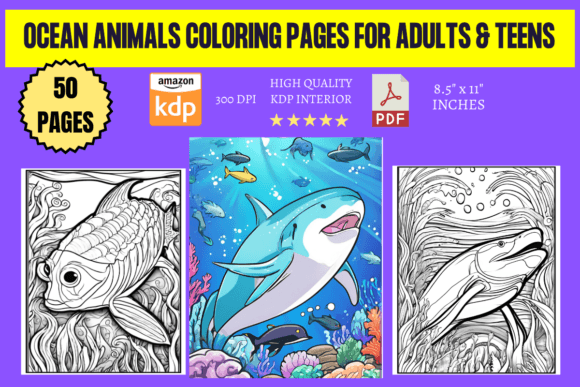
Ocean Animals Coloring Pages for Adults
Coloring isn’t just for children anymore—and Ocean Animals Coloring Pages for Adults reflect a meaningful shift in how people approach focus, creativity, and emotional well-being. What began as a nostalgic pastime has matured into a purposeful tool: one that supports mental clarity during high-demand workdays, offers tactile relief from screen fatigue, and invites intentional pauses in otherwise fragmented routines. This isn’t about escapism; it’s about re-engagement—with paper, with pattern, with presence.
A Digital Printable Designed for Real Life
This collection delivers 50 original ocean-themed coloring pages—each crafted with adults in mind. The designs balance intricacy and accessibility: flowing kelp forests, detailed seahorse silhouettes, layered coral reefs, and expressive marine mammals like dolphins and octopuses. Unlike mass-produced clipart compilations, these illustrations avoid repetition and prioritize visual rhythm—subtle linework, thoughtful negative space, and organic flow that invite sustained attention without frustration.
The files are delivered as high-resolution, print-ready assets: 50 PNGs and 50 JPGs at 300 DPI, sized to standard 8.5″ x 11″ paper. That means no scaling issues, no pixelation, and no guesswork—whether you’re printing at home, sending to a local print shop, or preparing files for Amazon KDP publishing. For creators building digital product libraries, educators sourcing classroom resources, or small business owners curating themed activity kits, this consistency saves time and preserves quality across use cases.
Why Ocean Themes Resonate—Now More Than Ever
Ocean imagery carries quiet psychological weight. Studies in environmental psychology suggest that aquatic motifs—especially when rendered with care—can evoke calm, reduce perceived stress, and support restorative attention. That’s not incidental. As remote work blurs boundaries between professional and personal space, many adults seek low-barrier ways to reset without stepping away entirely. A few minutes spent shading the gentle curves of a manta ray or tracing the fractal edges of a jellyfish tentacle becomes a micro-practice in grounding—not meditation by another name, but a parallel path.
At the same time, ocean conservation awareness is rising across age groups and professions. Teachers integrate marine biology themes into interdisciplinary units. Marketers develop eco-conscious brand campaigns. Freelance designers source nature-based assets for client projects. When an adult chooses Ocean Animals Coloring Pages for Adults, they’re often choosing alignment—not just with a hobby, but with values. The subject matter quietly reinforces connection to ecosystems, biodiversity, and stewardship—without lecturing or oversimplifying.
From Personal Practice to Professional Utility
For professionals who rely on visual thinking—educators, UX designers, content strategists—the act of coloring serves dual functions: it builds fine motor engagement while freeing up associative cognition. Many report breakthroughs in problem-solving or creative ideation during or immediately after coloring sessions. That’s because the task occupies the brain’s executive network just enough to quiet internal noise—leaving room for subconscious connections to surface. It’s not magic; it’s neurologically supported downtime.
Entrepreneurs and small business owners also find practical utility here. These 50 pages can be repurposed thoughtfully: printed as standalone activity sheets for wellness workshops, embedded in client onboarding packets for creative agencies, or adapted into social media visuals (with proper attribution and usage rights observed). Because the files are KDP-ready, launching a physical coloring book on Amazon requires only basic formatting and cover design—no illustration overhead. That lowers the barrier to entry for educators or marine science communicators wanting to reach broader audiences.
Designed for Flexibility—Not Just Completion
One overlooked strength of this collection is its adaptability across skill levels and intentions. Some users treat each page as a finished piece—framing completed works or sharing them in online communities. Others use them as warm-up exercises before sketching or writing. Still others scan completed pages into digital note-taking apps like Obsidian or Notion, layering annotations or reflections over the artwork. The high-resolution files support all of these workflows without degradation.
That flexibility extends to audience overlap. While marketed for adults, the pages are equally appropriate for teens developing fine motor control or younger children with supervision. Parents appreciate having a single resource that works across ages—especially during travel, rainy-day planning, or sibling-friendly downtime. Teachers use select pages for marine-themed lesson extensions: labeling anatomy on a sea turtle diagram, mapping habitats on a whale migration spread, or discussing symmetry using starfish outlines. The design avoids cartoonish simplification, offering visual fidelity that supports learning without sacrificing appeal.
What Changes When You Print—And Why It Matters
In a world saturated with digital consumption, the physicality of coloring remains significant. Holding paper, selecting tools—colored pencils versus gel pens versus watercolor pencils—introduces sensory variety absent from screens. That tactile feedback activates different neural pathways than scrolling or tapping. For freelancers managing back-to-back Zoom calls or writers facing blank-document paralysis, printing a single ocean animal page creates a deliberate transition point: a signal to shift gears, not just switch tabs.
But convenience shouldn’t compromise quality—and that’s where resolution and file structure matter. At 300 DPI, these images retain crisp lines even when enlarged for framing or projected for group activities. The PNG format preserves transparency for digital editing, while JPGs ensure broad compatibility for quick printing. No need to troubleshoot color profiles or bleed margins. That reliability matters when your time is measured in billable hours or classroom minutes.
Realistic Expectations, Real-World Value
This isn’t a productivity hack disguised as art therapy. It won’t replace sleep, therapy, or strategic planning. What it does offer is agency—a small, repeatable choice to engage differently with time. In a landscape where “self-care” often defaults to expensive subscriptions or time-intensive rituals, Ocean Animals Coloring Pages for Adults meet people where they are: with five spare minutes, a printer, and a pencil.
For creators building digital products, it’s a reminder that utility and aesthetics aren’t mutually exclusive. For educators, it’s a low-cost, high-impact supplement to existing curriculum. For marketers, it’s a tangible way to humanize a brand focused on sustainability or wellness. And for anyone navigating complexity—whether launching a startup, supporting aging parents, or balancing creative work with caregiving—it’s permission to pause, press pigment to paper, and remember the quiet depth beneath the surface.
Getting Started Is Intentional—Not Complicated
You don’t need special supplies to begin. A set of mid-range colored pencils, a standard printer, and access to the downloaded files are enough. Start with a page that draws your eye—not the most complex one, but the one that feels inviting. Notice how the line weight shifts across a dolphin’s dorsal fin, or how the tentacles of an octopus curl with implied motion. Let the hand move without demanding perfection. Over time, patterns emerge—not just in the artwork, but in how you return to focus, how you tolerate uncertainty, how you hold space for stillness amid motion.
These 50 pages aren’t meant to be rushed through. They’re designed to be revisited—to serve different needs on different days. One day, a humpback whale might anchor a breathing exercise. Another, a school of angelfish could spark a conversation with a child about cooperation or adaptation. The ocean, after all, is never static. Neither is the way we engage with it—even on paper.