Geometric Coloring Pages for Adults
Geometric coloring pages for adults offer more than relaxation—they’re a tactile design tool, a low-stakes creative exercise, and a surprisingly versatile asset for professionals across disciplines. Unlike freehand sketching or digital drafting, these pages provide structure with room for interpretation: clean lines, repeatable patterns, and intentional negative space invite focus without demanding technical skill. That balance makes them ideal for designers warming up before client work, educators building visual literacy, marketers prototyping layout ideas, or entrepreneurs developing branded printables.
A Resource Designed for Real Use
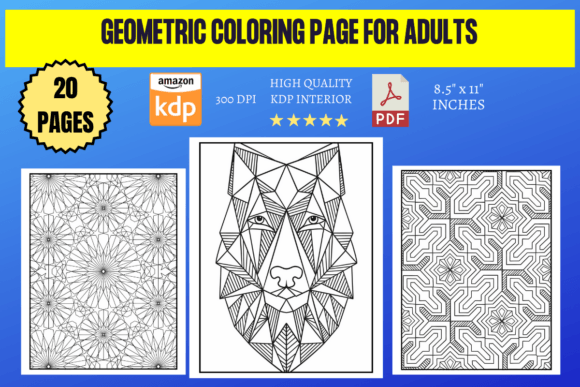
This set includes 20 high-resolution, print-ready geometric coloring pages—each sized at 8.5″ × 11″, delivered as both PNG and 300 DPI JPG files. They’re built for flexibility: use them as-is for personal practice, adapt them into workshop handouts, integrate elements into Canva templates, or upload directly to Amazon KDP for a no-layout-needed coloring book launch. No watermarks, no licensing restrictions—just clean, scalable geometry ready for your next project.
Why Geometry Works—Especially Now
Our visual environment is saturated with organic shapes, fluid interfaces, and algorithmically generated randomness. Geometric forms stand out because they signal intention, precision, and clarity. When you color within symmetrical polygons, tessellated grids, or radial mandalas, you’re not just filling space—you’re reinforcing spatial reasoning, pattern recognition, and rhythm awareness. These are transferable skills: a freelance illustrator refining composition instincts, a teacher demonstrating symmetry in a middle-school math unit, or a branding consultant testing how line weight affects perceived stability—all benefit from the same underlying discipline.
Creative Applications Beyond the Page
Don’t limit these pages to colored pencils and quiet afternoons. Here’s how different users apply them meaningfully:
- Designers & Illustrators: Trace over printed pages to study proportion, spacing, and balance. Use scanned, recolored versions as texture overlays in digital mockups—or isolate individual motifs (like hexagons or chevrons) to build custom pattern libraries in Adobe Illustrator.
- Educators & Trainers: Print one page per student and assign specific constraints—e.g., “Use only three colors,” “Alternate warm and cool tones,” or “Highlight every third shape.” These simple parameters turn coloring into an accessible lesson on contrast, hierarchy, and visual sequencing.
- Content Creators & Bloggers: Photograph your finished pages with natural lighting and subtle backgrounds. Share time-lapse videos of the process on Instagram Reels or TikTok—not as “art therapy” spectacle, but as documentation of deliberate creative choice. Caption with specifics: “How shifting saturation in this tessellation changes perceived depth.”
- Small Business Owners: Bundle five pages as a lead magnet (“5 Geometric Coloring Pages for Focus”)—then follow up with a short email series on applying those same principles to logo refinement or website wireframing. The coloring becomes a gateway to deeper value.
Keeping It Original—Without Reinventing the Wheel
Originality here isn’t about avoiding familiar shapes—it’s about *how* you engage with them. A starburst doesn’t need to be redrawn to feel fresh. Try these grounded approaches:
- Restrict your palette intentionally. Choose two complementary hues and a neutral—and commit. Notice how limited options sharpen decision-making and highlight structural relationships between shapes.
- Work from the center outward—or vice versa. Starting at the periphery forces attention to edge treatment and framing; beginning centrally builds toward resolution. Both reveal different aspects of the design’s logic.
- Scan and invert. Flip the image horizontally or convert to grayscale after coloring. This disrupts expectation and often surfaces unexpected harmonies—or reveals imbalances worth addressing in future iterations.
Practical Tips for Consistent, Audience-Friendly Results
If you’re sharing or selling these pages—even as part of a larger offering—clarity matters more than complexity. Here’s what ensures usability:
- Test print first. Even at 300 DPI, some printers compress fine lines. Run a single-page test on your target paper stock (e.g., 100 lb. matte cover vs. standard copy paper) to confirm line integrity and bleed margins.
- Label thoughtfully. If distributing digitally, name files descriptively: geometric-tessellation-07.png, not page12.jpg. For KDP uploads, include “geometric coloring pages for adults” naturally in your subtitle and description—but avoid stuffing it into filenames or alt text.
- Group by function, not just form. In a multi-page PDF, cluster pages by complexity (beginner/intermediate/advanced), by motif type (radial, linear, modular), or by intended use (mindful focus, pattern study, color theory practice). This helps users self-select—not guess.
Who Benefits Most—and How
This isn’t just for people who “like to color.” It’s for the UX researcher mapping cognitive load through visual repetition. The educator needing a non-verbal way to teach rotational symmetry. The indie publisher launching a niche activity book with minimal design overhead. The marketer prototyping icon systems using consistent stroke weights and angular relationships. Each of these roles finds utility—not novelty—in the predictability of geometry.
What sets this collection apart is its readiness for action. These aren’t decorative placeholders. They’re designed to be marked on, scanned, layered, cropped, annotated, and repurposed—with no setup required. You don’t need design software to start. You don’t need art training to see results. You do need curiosity about how structure supports creativity—and willingness to treat each page as a working document, not just a finished product.
Next Steps—Simple, Scalable, Sustainable
Pick one page. Set a 12-minute timer. Use only black ink and one accent color. Observe where your eye lingers, where resistance shows up, where decisions feel automatic versus deliberate. That’s not “just coloring.” That’s applied visual research.
Then scale: share that insight in a team huddle. Turn the timed exercise into a 90-minute workshop module. License the files for internal training use. Embed a preview page in a landing page to demonstrate tone and precision before someone downloads your full resource.
Geometric coloring pages for adults succeed when they serve a purpose beyond aesthetics—when they become infrastructure for thinking, teaching, designing, and communicating. The 20 pages here aren’t an endpoint. They’re calibrated starting points—ready for your voice, your goals, and your next real-world application.