Truck SVG Files for Creative Projects
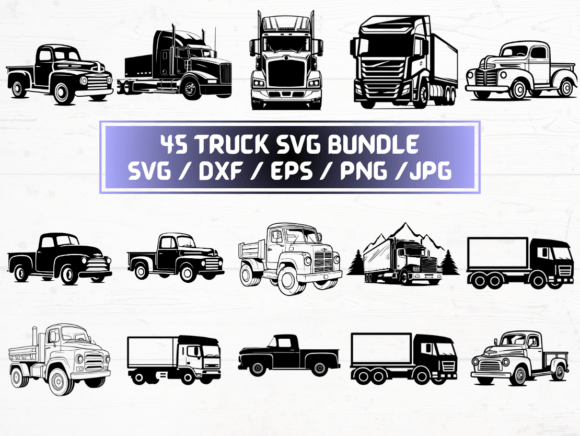
If you’re designing custom apparel, signage, vehicle wraps, or marketing materials—and need crisp, scalable truck graphics—you’ll want files that adapt cleanly across tools and outputs. That’s where Truck SVG comes in: a curated set of 45 distinct truck-themed vector and raster assets, delivered digitally in five industry-standard formats. No waiting for shipping. No physical limitations. Just immediate access to files engineered for real-world flexibility.
Why Format Variety Matters More Than You Think
Not all design workflows are the same—and neither are your output needs. A vinyl cutter operator relies on clean paths and precise node control (DXF), while a social media manager needs ready-to-drop PNGs with transparent backgrounds. An illustrator may prefer editing layers in Illustrator using EPS, and a web developer might embed SVG directly into HTML for responsive scaling. This collection includes all five: SVG, DXF, EPS, PNG (300 dpi, transparent background), and JPG. Each file is individually optimized—not auto-converted—so line integrity, corner sharpness, and color fidelity hold up whether you’re laser-cutting a metal sign or placing a graphic on an e-commerce banner.
Real Use Cases—Where These Files Save Time and Reduce Frustration
Consider a small fleet owner updating branded decals for five delivery vans. They need consistent, legible truck icons at varying sizes—small on side doors, large on rear panels. With these Truck SVG files, they can scale one vector without pixelation, export to DXF for their local sign shop, and also grab the matching PNG to upload instantly to their Google Business profile. No redrawing. No font dependency. No guessing whether a “free download” from an unvetted site will open correctly in Cricut Design Space.
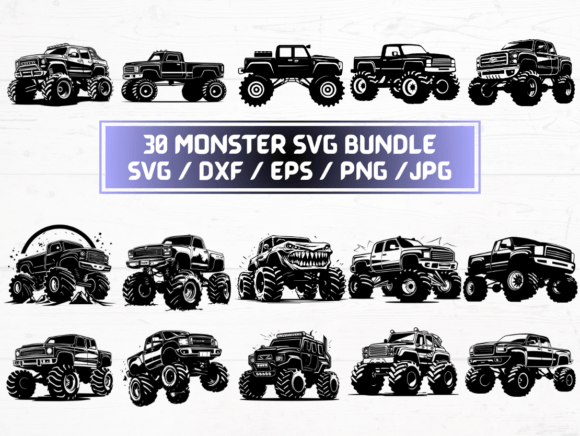
Or imagine a freelance educator building a transportation-themed unit for elementary STEM. They need printable worksheets, interactive whiteboard assets, and slide deck visuals—all with clean outlines and no background clutter. The included PNGs (300 dpi, transparent) drop cleanly into Canva or PowerPoint. The SVGs animate smoothly in web-based learning platforms. And because each of the 45 designs is unique—pickup trucks, semi-trailers, vintage rigs, dump trucks, tow trucks—they avoid visual repetition across lesson materials.
Who Benefits Most—and Why It’s Not Just About “Trucks”
This isn’t only for trucking companies or logistics brands. Graphic designers use Truck SVG assets as modular components—combining them with road textures, city skylines, or cargo elements to build custom scenes. Bloggers covering infrastructure or supply chain topics embed SVGs directly into posts for fast-loading, accessible illustrations. Crafters running Etsy shops apply the DXF files to cut layered wood signs or acrylic keychains. Even non-profits organizing community transport initiatives use the JPG versions for clear, professional flyers—no licensing concerns, since these are original, royalty-free digital assets.
The consistency across formats means fewer workflow breaks. If you start in Inkscape (which handles SVG and EPS well), then move to Silhouette Studio (which reads DXF reliably), then export final artwork as high-res PNG for client review—you won’t hit missing fonts, misplaced strokes, or flattened layers. That continuity reduces revision cycles, especially when collaborating across tools or skill levels.
Transparency, Resolution, and Practical Output Readiness
The 45 PNG files aren’t just “transparent”—they’re exported at true 300 dpi with anti-aliased edges and alpha-channel transparency. That means they print sharply on business cards or brochures without halos or fringing. The JPGs serve a different purpose: smaller file size for email attachments, CMS uploads, or quick mockups where absolute transparency isn’t needed—but color accuracy and compression stability still matter. Neither format requires post-processing; they’re production-ready out of the ZIP folder.
A Note on Scalability vs. Stylistic Fit
SVG is inherently resolution-independent, but scalability alone doesn’t guarantee suitability. These Truck SVG files were created with balanced stroke weights, simplified anchor points, and intentional negative space—so they remain legible even when scaled down to 24px for website favicons or up to 6 feet wide for trade show banners. That attention to construction separates them from generic clipart. Still, if your project demands photorealistic detail (e.g., a technical manual showing engine components), these stylized, clean-line trucks won’t replace high-fidelity 3D renders. They excel in branding, illustration, signage, and education—not photogrammetry.
No Physical Item—But Real Workflow Value
This is a digital-only product: no USB drives, no printed swatches, no inventory delays. You receive a single ZIP folder containing all 225 files (45 per format), organized clearly by type. There’s no subscription, no watermark, no usage cap. You own the files for commercial and personal use—ideal for agencies managing multiple clients or educators reusing assets across school years. Because it’s instant download, there’s no waiting during tight deadlines—whether you’re prepping for a craft fair this weekend or launching a new service page before Monday morning.
When to Consider Alternatives
If you need animated truck icons (e.g., for a loading screen), SVG alone won’t suffice without added CSS/JS—this collection is static. If your CNC router requires specific toolpath parameters or nesting templates, these DXF files provide geometry but not machine-specific setup. And if brand guidelines require strict Pantone matching, verify color values in your software before final output—the files use standard RGB/CMYK profiles, not proprietary spot-color definitions. For most common applications—cutting, printing, web, presentation—the formats here align precisely with industry expectations.
Getting Started Is Deliberately Simple
Once downloaded, extract the ZIP. Organize by use case: keep the SVG folder open in your vector editor for edits, the PNG folder handy for drag-and-drop into layout tools, and the DXF folder ready for your cutting software. No registration, no activation keys, no cloud sync required. Because each format serves a distinct function—and all 45 designs are mirrored across them—you avoid format-hopping guesswork. That reliability adds up: less time troubleshooting imports, more time refining messaging, building prototypes, or meeting client expectations.
Final Thought: Precision Assets Enable Better Decisions
Having the right file at the right time doesn’t just speed up execution—it supports clearer communication. A nonprofit choosing between three truck icon sets can compare how each renders at thumbnail size in their donor report. A teacher previewing a worksheet can test contrast and readability before printing 30 copies. A startup validating a logo concept can layer the SVG over actual vehicle photos to assess proportion and visibility. These Truck SVG files don’t promise viral growth or overnight success—but they do remove friction from tasks where visual clarity and technical reliability directly impact outcomes.